- Synthetic: Leadership Intelligence
- Posts
- The Rise of Good-enough AI
The Rise of Good-enough AI
Token prices are rising. CFOs are concerned. The answer is smarter model allocation.

Steve Brown
July 07, 2026
Subscribe to Synthetic
Remember, you can read past editions of Synthetic here.
AI token costs are rising, but the answer isn’t to slow down. Learn why business leaders need good-enough AI and smarter model allocation.
The Rise of Good-enough AI
AI token costs are rising, and CFOs have noticed. Commentators like Scott Galloway have declared from the sidelines that the AI bubble is about to burst because of these high costs. And some boards have started to ask whether all this AI spending is really worth it. Is it time to panic?
Let’s step back for a moment and look at this rationally.
The current version of the argument goes something like this: AI tokens are too expensive and employees are burning through them too quickly. The latest frontier models like Fable 5 cost too much to serve and the productivity gains they offer are not yet obvious enough. Therefore, the market is overvalued, the ROI is weak, stocks will tumble, and the smart move in the CFO’s office is to clamp down on usage.
It’s true that AI usage is no longer an abstract line item and has become a real operating cost. But that’s a now thing. Costs will come down, and quickly. Treating rising token costs as evidence that AI is failing is the wrong conclusion.
The problem is not that companies are using too much AI. It’s that many are using the wrong AI for the wrong work. Not every task needs a genius. At the end of the day, intelligence is a resource. And like any resource, it needs to be matched to the job. You don’t need a brain surgeon to apply a bandage. And you don’t need the most expensive frontier model on earth to answer routine customer support questions, summarize standard documents, classify tickets, generate first drafts, or route internal requests.
Each job needs enough intelligence to do it reliably, safely, and economically. This moment signals the rise of good-enough AI.
How good is good enough?
Good-enough AI doesn’t mean crappy AI. It means choosing the least expensive model that can meet the performance, accuracy, latency, privacy, and reliability requirements of each task.
For some work, that will still be a frontier model. Complex coding, strategic reasoning, scientific research, high-stakes analysis, and some multi-step agentic workflows will require the smartest models you can get your hands on. These are areas where using the best model creates competitive advantage, and where paying a premium makes sense. But the majority of enterprise work doesn’t live at the frontier. It’s repetitive, bounded, structured, and predictable work that doesn’t need maximum intelligence.
Costs will come down, fast
Today’s frontier models are expensive to serve. They require large amounts of compute to run them, and they’re currently optimized for capability, not cost. The current frontier champion, Claude Fable 5 has swept the board on all the intelligence benchmarks, but it costs of 100x per task versus open-source competitors like DeepSeek v4 and GLM-5.2. As demand for leading models explodes, providers can charge a premium. (They need to just to cover the cost of serving them in their current state). But leaders should recognize that this is just a moment on the cost curve, not a permanent state.
History shows that technology gets cheaper, smaller, faster, and more widely available over time. Over the last few years, AI has followed the same pattern, only much faster. Stanford’s AI Index found that the cost of querying a model with roughly GPT-3.5-level performance fell from $20 per million tokens in late 2022 to $0.07 by late 2024 — a more than 280-fold decline in under two years. Depending on the task, inference prices have fallen between 9x and 900x per year.

Epoch AI found a similar pattern: the cost to achieve a fixed level of benchmark performance has dropped dramatically, with some performance thresholds falling around 40x per year. So a task that cost $40 to complete a year ago now costs a dollar. The direction is clear. As capability diffuses, costs collapse. What is premium today becomes commodity tomorrow.
I respect Scott Galloway, but his “tokens are expensive, therefore AI is over” argument misses the bigger picture. He’s asking the wrong question and making the wrong assumptions. Yes, frontier models are expensive today, perhaps too expensive. But the real question is, “How fast will today’s frontier capability become tomorrow’s cheap utility?” The answer is: very soon.
The frontier will keep moving upwards, and be expensive. But as leading models get more capable, yesterday’s frontier gets distilled, pruned, quantized, compressed, open-sourced, optimized, and deployed at a fraction of the cost. And the hardware to run these models also becomes far more efficient, generation to generation. NVIDIA claims that their forthcoming Vera Rubin platform will deliver tokens at 1/10th the cost of the previous Blackwell generation. And when paired with their Groq 3 LPX chips and running a trillion-parameter model it delivers up to 35x higher throughput per megawatt. NVIDIA has a page dedicated to token economics here.
Custom chips from Amazon, OpenAI, Anthropic, and Google are also expected to make significant performance gains for coming generations. The hardware gets more efficient and the models themselves become leaner and faster to run for the same level of intelligence. Those two factors multiply. So if the model itself becomes 10x more efficient through distillation, quantization, pruning and other techniques, and the hardware running it gets 35x more efficient, everything gets 350x cheaper.
Enterprises need a flexible model portfolio
Leaders should think about AI is a tiered intelligence market with premium intelligence at the top for tackling the hardest problems, good-enough intelligence in the middle that’s cheap and capable enough to handle most enterprise workflows, and embedded intelligence at the bottom. These small models run inside products, devices, and simple workflows, and may not even be visible to the user.

Not Every Task Needs a Genius
Smart companies won’t just choose one model or one provider. They will build a portfolio of models from a variety of vendors, using frontier capabilities where reasoning depth matters and simpler models for cost and speed. Enterprise AI architectures should be built for flexibility, able to swap in and out models to take advantage of whichever provider offers the best capabilities at a given price point.
A blend of models will suit most companies best. They might use frontier models for coding new capabilities. They might use open-weight models where control and customization matter. And specialized models where accuracy in a narrow domain matters. Intelligent model routers will send each task to the right level of intelligence, automatically. Leading companies won’t just adopt AI, they will allocate intelligence…well…intelligently. 😀

Intelligent routers send tasks to models with the appropriate level of intelligence
Chinese models are the canary in the coal mine
Developers and startups are turning to lower-cost Chinese models like Qwen, Kimi, and DeepSeek because they can handle many everyday tasks at a fraction of the price of leading U.S. models, while reserving premium models for the hardest work. What matters here is capability per unit of inference cost.
For business leaders, the lesson is not “use Chinese models.” There are real issues around data security, privacy, jurisdiction, vendor trust, and governance. In many enterprises, especially regulated ones, those concerns will limit or prevent the use of some models and providers. The deeper lesson is that the market is hungry for good-enough AI, models that are not the smartest in the world, but are smart enough, fast enough, cheap enough, and controllable enough to be used everywhere. Google has responded to this need with their Gemma line of open-source models. OpenAI’s gpt-oss model is an attempt to play in this space but probably doesn’t fit into the “good enough” category today.
What should CFOs do?
The CFO response to AI cost inflation should not be to shut usage down. It should be to impose intelligence discipline. A blanket token cap is a blunt instrument. It may control spend, but it can also suppress learning, slow adoption, and punish the teams that are doing the most to build AI fluency and deliver results. Worse, it could cost you competitive advantage and sends the wrong message: “Use less AI,” when the better message might be, “Use the right AI.”
A good friend of mine—I was his best man many years ago—works in an AI-focused healthcare company in the UK. He told me last week that higher-ups were demanding major project milestones from AI coding tools, but had set a £30/month usage limit on developers. Under heavy constraint, the IT team had to point out that results require resources, just as they do for human capital.
CFOs should become the architects of AI economics and ask sharper questions. Which workflows justify premium models? Which can move to cheaper models? Which tasks can be cached, batched, compressed, or handled by smaller systems? Where does latency matter? Where does accuracy matter? Where does explainability matter? Where does privacy matter? Where are we paying for intelligence we don’t need? And (most importantly) where is frontier intelligence necessary and an investment in our future?
Companies that answer these questions won’t just spend less, they’ll learn faster. Specifically, which work requires deep reasoning and which work requires reliable pattern matching. When to pay for the frontier and when to ride the falling cost curve. They will learn how to scale AI without letting costs spiral out of control. And most of all, they’ll learn how to build an agile IT infrastructure that can adapt to ever-shifting market conditions for AI and automatically route tasks to the appropriate model.
So, is there a bubble?
Yes, some AI valuations may be ahead of near-term fundamentals, some companies are spending foolishly, and some AI pilots will fail to produce value. That happens in every major technology transition. But the cost of intelligence is falling rapidly and the supply of usable models is expanding. The tools for routing, monitoring, evaluating, and governing model usage are improving, and the number of tasks that can be handled by good-enough AI is growing every day. AI deployment is just beginning and I expect continued investment and infrastructure build-out for years to come.
In the early days of the internet, companies argued about whether they could afford bandwidth, servers, and websites. Then the costs fell, the infrastructure matured, and the question changed. The winners were not the companies that avoided the internet until it became cheap. The winners were the companies that learned how to build around the technology before everyone else did.
AI is moving through the same transition as the internet. If phase one of AI was amazement and wonder, phase two is about cost discipline. Good-enough AI is the key. And it’s how we get to phase three, which is full industrialization of AI., where an invisible layer of intelligence runs through the entire business.
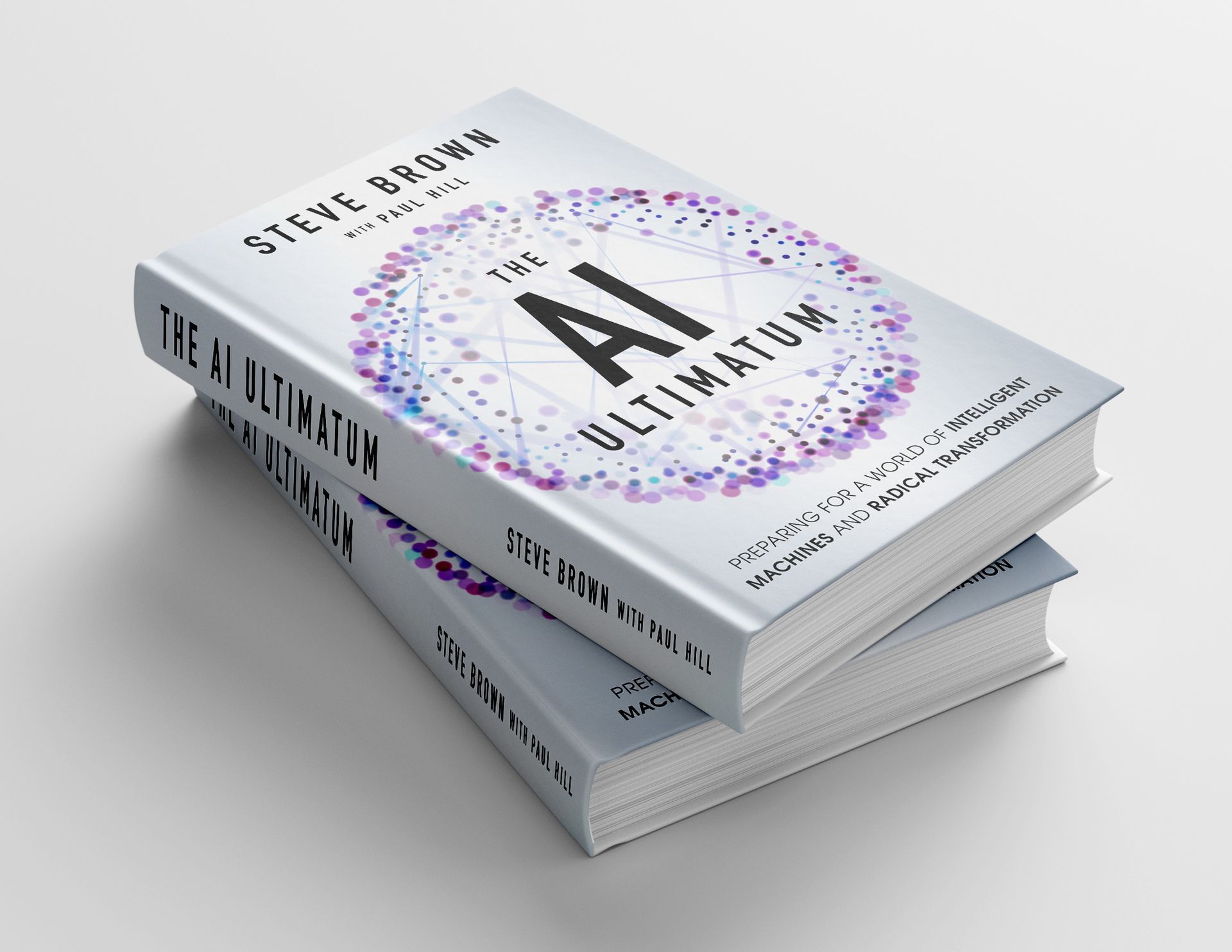
Leaders must stop thinking of AI as a single product and start thinking of it as a system of intelligence. Some intelligence will be scarce and expensive, but most will be abundant and cheap. Winners will know the difference. As I wrote in my book, The AI Ultimatum, the future cost of digital employees will trend down towards zero.
The future of enterprise AI will not be built only on the smartest models. It will be built on the smartest allocation of models. And very often, the winning answer will be “good enough.”
Steve Brown is an AI futurist, global keynote speaker, and author. He advises Fortune 100 companies and global brands on AI strategy and transformation, helping them build AI-first organizations and stay ahead of the forces reshaping business, the economy, and society. He has delivered hundreds of high-impact keynotes across five continents, translating complex technologies into clear, practical action for leaders.
Steve’s latest book is “The AI Ultimatum: Preparing For a World of Intelligent Machines and Radical Transformation.” Get his book here, and learn more about Steve at www.stevebrown.ai.