- Synthetic: Leadership Intelligence
- Posts
- The Case for AI Data Centers: Let's Look at the Numbers
The Case for AI Data Centers: Let's Look at the Numbers
A fact-based analysis of the pros and cons for communities

Steve Brown
October 01, 2026

Subscribe to Synthetic
Remember, you can read past editions of Synthetic here.
The public debate on “to data center or not to data center” has often based on erroneous or old data. Increasingly, leaders are being asked for their opinions on the merits of data centers or having to defend corporate infrastructure investments. This week, we dive into some of the facts on data centers and take an unvarnished look at the pros and cons of having a data center in your community. Data centers certainly bring challenges, but (spoiler alert), built in the right place and to the right specifications, they can be an amazing net positive to a community.
Here’s what every leader needs to know….
When AI Starts Improving AI
Recursive Self Improvement Could Change The Speed Limit Of AI Progress

AI data centers have become the new power plants, factories and airports of public debate. We want the services they provide, but many people don't want the infrastructure nearby. The concerns aren't imaginary. Data centers consume electricity and water. They take up land, can create noise and bring construction traffic.
But hard questions deserve good numbers. When you put the footprint of data centers into context, a different picture emerges. Their economic and strategic value is enormous, many impacts can be engineered down dramatically, and America will be better served by building them well than by trying not to build them at all.
1. Start with water
According to Lawrence Berkeley National Laboratory's 2024 United States Data Center Energy Usage Report, U.S. data centers directly consumed about 17.4 billion gallons of water in 2023.
That sounds enormous, because almost any number measured in billions of gallons sounds enormous. Context changes the picture.
U.S. golf courses applied about 1.63 million acre-feet of water in 2024, according to the Golf Course Superintendents Association of America's national water-use survey. That's roughly 531 billion gallons. So the direct water consumed by all U.S. data centers was about one-thirtieth of the water applied to American golf courses.

If we’re going to worry about water, let’s focus on golf courses and almond farms first…
It's not a perfect apples-to-apples comparison. The figures come from adjacent years and "water applied" isn't identical to "water consumed." But it gives you a useful sense of scale.
Almonds offer another perspective. According to the USDA, California had about 1.38 million bearing acres of almonds in 2024. UC Cooperative Extension says mature almond trees in the Sacramento Valley can use about 41 to 44 inches of water per acre in an average unrestricted year, with higher use possible farther south.
Spread that across California's almond acreage and you're talking about crop water use on the order of 1.5 trillion gallons a year. That's not the same thing as irrigation water withdrawn, because some of the crop's needs may be supplied by rainfall and soil moisture. And it's certainly not an argument against almonds. I like almonds. It's an argument for perspective.
There is also a bigger water footprint beyond the data center itself. Berkeley Lab estimates that electricity generation supplying U.S. data centers consumed another 211 billion gallons of water in 2023. That matters. But it also tells us something important: the water footprint of AI depends partly on how we generate the electricity powering it.
Most importantly, water is local. A gallon consumed in a water-rich region isn't equivalent to one consumed in a drought-stressed community. The right question isn't, "Do data centers use water?" Of course they do. It's, "Is this facility using the right cooling technology in the right place?"
2. Cooling technology is changing fast
A lot of criticism assumes tomorrow's data centers will cool themselves exactly like yesterday's. They won't.
Traditional evaporative cooling rejects heat by evaporating water. Closed-loop systems can circulate coolant through the facility and reject that heat without continually consuming water.
Microsoft, for example, introduced a new data center design using chip-level cooling in a closed loop that consumes zero water for cooling during normal operation. The company says the design can avoid more than 125 million liters, around 33 million gallons, of water per data center every year.

Data center cooling isn’t what it used to be
That doesn't mean every data center is there yet, and it doesn't make cooling free. Dry or closed-loop cooling can involve energy and engineering tradeoffs. But it does mean high water consumption isn't an immutable law of computing. Increasingly, it's a design decision. And dual-phase, closed-loop cooling offers the best benefits of all. Instead of a knee-jerk reaction to try and ban data centers to preserve fresh water, perhaps we should just demand that any new data center uses dual-phase, closed-loop cooling.
3. Electricity is the harder problem
This is where skeptics have the strongest case.
Data centers consumed about 4.4 percent of U.S. electricity in 2023, according to the Department of Energy and Berkeley Lab. Current projections suggest that could rise to around 6.7 to 12 percent by 2028. Those are big numbers, and pretending otherwise weakens the argument for building them.
But there's another way to see this. America needs to build more electricity because an electricity-intensive new industry is arriving.
We've done this before. When factories electrified, we built generating capacity. When cars arrived, we built roads. When aviation expanded, we built airports. Infrastructure follows economically valuable new demand.
This is where the emerging idea of Bring Your Own Power, or BYOP, matters. Instead of simply plugging a huge new data center into the existing grid and expecting everyone else to accommodate it, developers can bring new generation, storage, microgrids or other dedicated power infrastructure with them.
The Department of Energy is explicitly encouraging onsite power generation and storage for large energy users, including data centers, noting that these technologies can reduce the amount of electricity facilities need to pull from the grid. Federal regulators are also developing new rules for co-locating large data-center loads directly with generating resources while protecting grid reliability and other electricity customers.
That's the model I'd like to see become normal. If you want to build a gigawatt-scale AI campus, bring substantial new power capacity with you and make sure the economics don't shift the cost of serving you onto households.
4. "They don't create jobs" is only half true
Here again, the skeptics have a point. Data centers aren't factories filled with thousands of permanent workers.
Virginia's independent Joint Legislative Audit and Review Commission found that a typical 250,000-square-foot data center might employ around 50 full-time workers once operational, compared with roughly 1,500 workers onsite at peak construction. Those construction jobs include electricians, pipefitters, HVAC technicians and equipment operators. Construction typically lasts 12 to 18 months, while development of an entire campus can stretch over several years.
Data centers aren't giant permanent-employment engines. But the huge capital investment leads to skilled construction work, well-paid operational jobs, supplier activity, and a durable tax base. JLARC estimates Virginia's data-center industry contributes around 74,000 direct and indirect jobs, $5.5 billion in labor income and $9.1 billion in state GDP annually, with much of that economic impact driven by construction and capital investment rather than ongoing staffing.
5. What does that tax base actually buy? Ask Loudoun County
Loudoun County, Virginia, has lived with data centers at scale longer than almost anywhere else in America. In fiscal 2026, data centers generated about $1.2 billion in real and personal property tax revenue, equivalent to 39 percent of the county's budget. And we know what happened to some of that money because the county tells us.
Loudoun says data-center revenue has enabled it to fund increased school budgets, public safety, libraries, parks and recreation, child protection and mental health programs. It has also helped pay for capital projects including schools, roads and bridges, while allowing the county to reduce taxes and fees for residents.
That's what a data center can be to a community. It isn't just a large gray building full of GPUs. It can be a tax-generating asset that requires relatively few public services while helping pay for services everyone uses.
Loudoun also offers a warning. The county has established a Revenue Stabilization Fund because becoming too dependent on one industry creates its own risk. That's sensible. The lesson isn't "build anything anywhere." It's "capture the upside and manage the risk."
6. Land and noise are real, but they're largely siting problems
Data-center campuses can occupy substantial amounts of land. Cooling equipment, transformers and backup generators can also create noise. Those impacts matter enormously if the building is beside your home. But these aren't new categories of engineering problem. When Fairfax County, Virginia, studied data-center noise, it identified cooling systems and backup generators as the main sources and examined measures including equipment enclosures, separation from sensitive uses and sound mitigation.
The answer is better zoning, meaningful setbacks, landscaping, acoustic barriers, sensible generator-testing rules and careful site design. A data center beside a subdivision can be a terrible idea without data centers themselves being a terrible idea.
7. Building on Earth is getting hard enough that we're looking to orbit
Permitting, power availability, transmission connections, land costs and community opposition can all slow construction. The constraints have become significant enough that some companies are starting to explore a solution that sounds like science fiction.
Google's Project Suncatcher is researching whether interconnected satellites carrying Google's TPU AI chips could eventually support large-scale machine-learning workloads in orbit, where solar panels could access near-continuous sunlight. Google is preparing an orbital prototype to test the technology. Meanwhile, Starcloud launched a satellite carrying an NVIDIA H100 GPU in 2025 and has already run AI workloads in orbit.

Data centers will eventually move to space, alongside internet communications infrastructure
Orbital data centers aren't about to replace terrestrial ones. Cooling in a vacuum, launch economics, radiation and high-bandwidth networking remain formidable problems. But the fact that serious companies are even exploring space tells you something about how valuable compute has become.
The choice isn't data centers or no data centers
AI infrastructure is going to be built. The real question is where, how and by whom. As Coreweave CEO Michael Intrator put it in a Bloomberg interview this week, "Moratoriums do not alter the demand for compute, they simply move where the compute is going to be built."
If America makes it unnecessarily difficult to build data centers, power generation and the infrastructure around them, demand for compute won't disappear. Some of the investment can move elsewhere. So can companies, talent, tax revenue and technological leadership. Interestingly, Native American reservations are interested to cash in on the huge revenue-generating opportunities that AI data centers present. Communities need to shift their demands from "no data centers" to "only data centers that make our lives better."
Don't Ban Data Centers, demand They Serve Communities
We should demand high standards. Put water-intensive cooling where water is plentiful and favor closed-loop or low-water systems where it isn't. Make developers contribute the power and grid capacity their facilities require so net power bills drop for the communities that host data centers. Keep large campuses appropriately separated from homes. Enforce noise limits. Structure tax agreements so communities share in the economic upside. And be honest about the relatively small number of permanent jobs.
Built properly, data centers can be an incredible boon for communities. Railroads used land. Factories used power. Highways changed communities. Airports make noise. Every major infrastructure system that enabled a new era of economic growth came with costs that had to be managed.
AI data centers are the physical infrastructure of an intelligence economy. The goal shouldn't be to stop them. It should be to build them intelligently.
Steve Brown is an AI futurist, global keynote speaker, and author. He advises Fortune 100 companies and global brands on AI strategy and transformation, helping them build AI-first organizations and stay ahead of the forces reshaping business, the economy, and society. He has delivered hundreds of high-impact keynotes across five continents, translating complex technologies into clear, practical action for leaders. Book him to speak at your next event here.
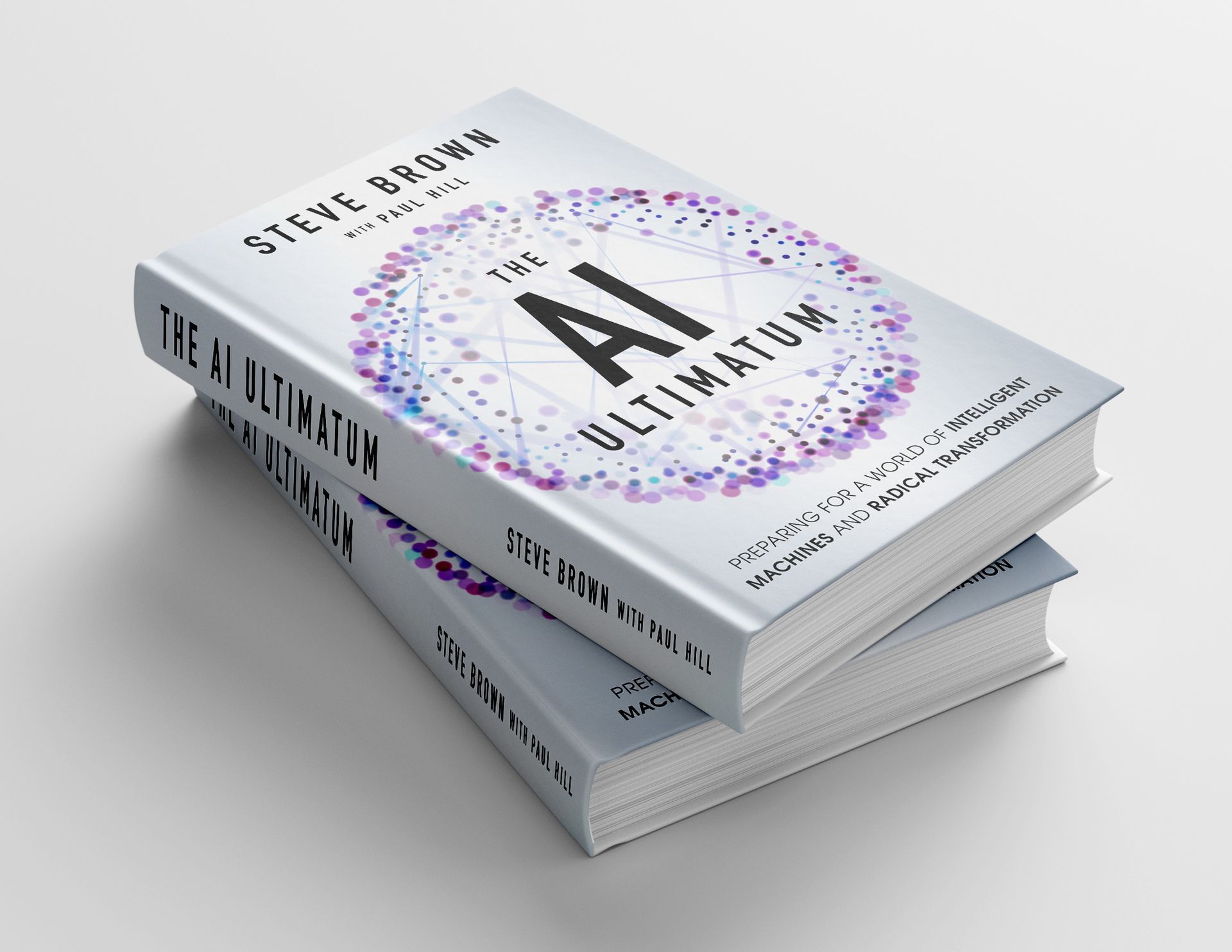
Steve’s latest book is “The AI Ultimatum: Preparing For a World of Intelligent Machines and Radical Transformation.” Get his book here, and learn more about Steve at www.stevebrown.ai.