- Synthetic: Leadership Intelligence
- Posts
- Becoming 'AI-First'
Becoming 'AI-First'
Why the next wave of transformation will redesign entire organizations around intelligent machines

Steve Brown
March 12, 2026
In partnership with

Subscribe to Synthetic
Remember, you can read past editions of Synthetic here.
We’re shifting the format of the Synthetic newsletter. With so many outlets already summarizing AI news, we’ll now focus on a single deep-dive topic we believe matters most to you.
This week, we kick off with AI-first organizations—why they matter, what’s at stake, and how companies can start moving.
Becoming AI-First
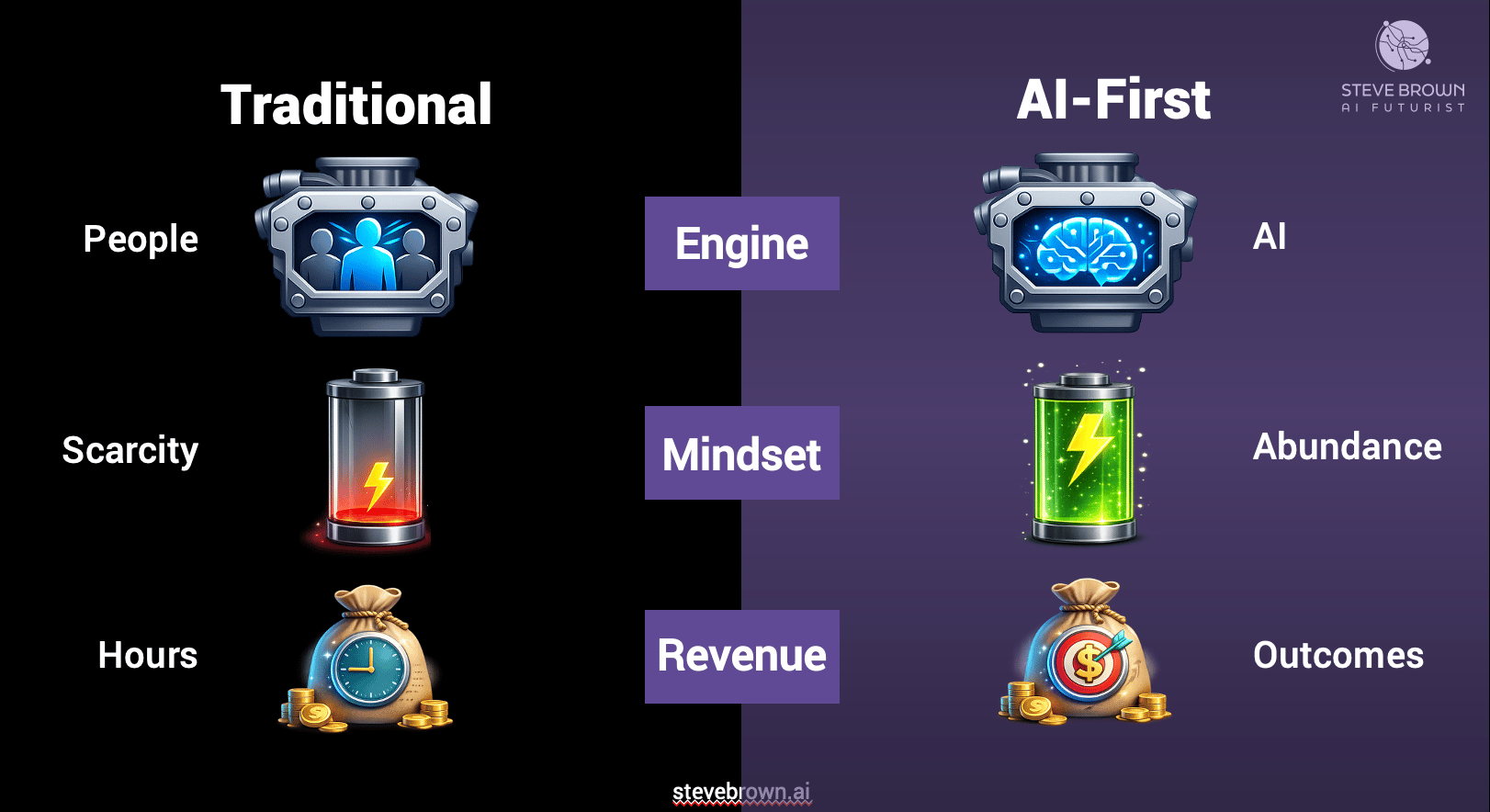
Digital transformation changed how companies operate. AI will change what organizations are.
For the past 25 years, companies have been trying to become digital-first.
They moved their processes online.
They built websites and mobile apps.
They digitized customer interactions.
They migrated their infrastructure to the cloud.
These were major shifts. But they were still built around the same core idea: Humans did the thinking. Software helped execute the work.
AI changes the equation entirely.
For the first time in history, intelligence itself becomes a scalable resource—something that can be embedded into every workflow, product, and decision. Reasoning. Analysis. Planning. Creativity. Capabilities that once required highly trained humans can now be performed—instantly and at scale—by machines.
And not just inside software. AI is now moving into the physical world through AI-powered robots and autonomous systems, capable of performing work in warehouses, hospitals, construction sites, farms, and factories.
The result is a new kind of organization: The AI-first company.
This represents something far bigger than simply adopting AI tools.
What Is An AI-First Organization?
Most companies today are experimenting with AI. They’re drafting emails with ChatGPT, generating marketing copy, and summarizing meetings. Some are automating bits and pieces of workflows.
That’s a good start. But those improvements are incremental. They’re not transformation.
An AI-first company doesn’t just use AI—it reorganizes the entire business around it.
That means redesigning how work gets done when intelligence is abundant, cheap, and always available.
Instead of asking: “Where can we add AI?” AI-first organizations ask a more powerful question: “How should this work if intelligence were built into the system from the start?”
That question changes the entire design of the organization.
A Pattern We’ve Seen Before
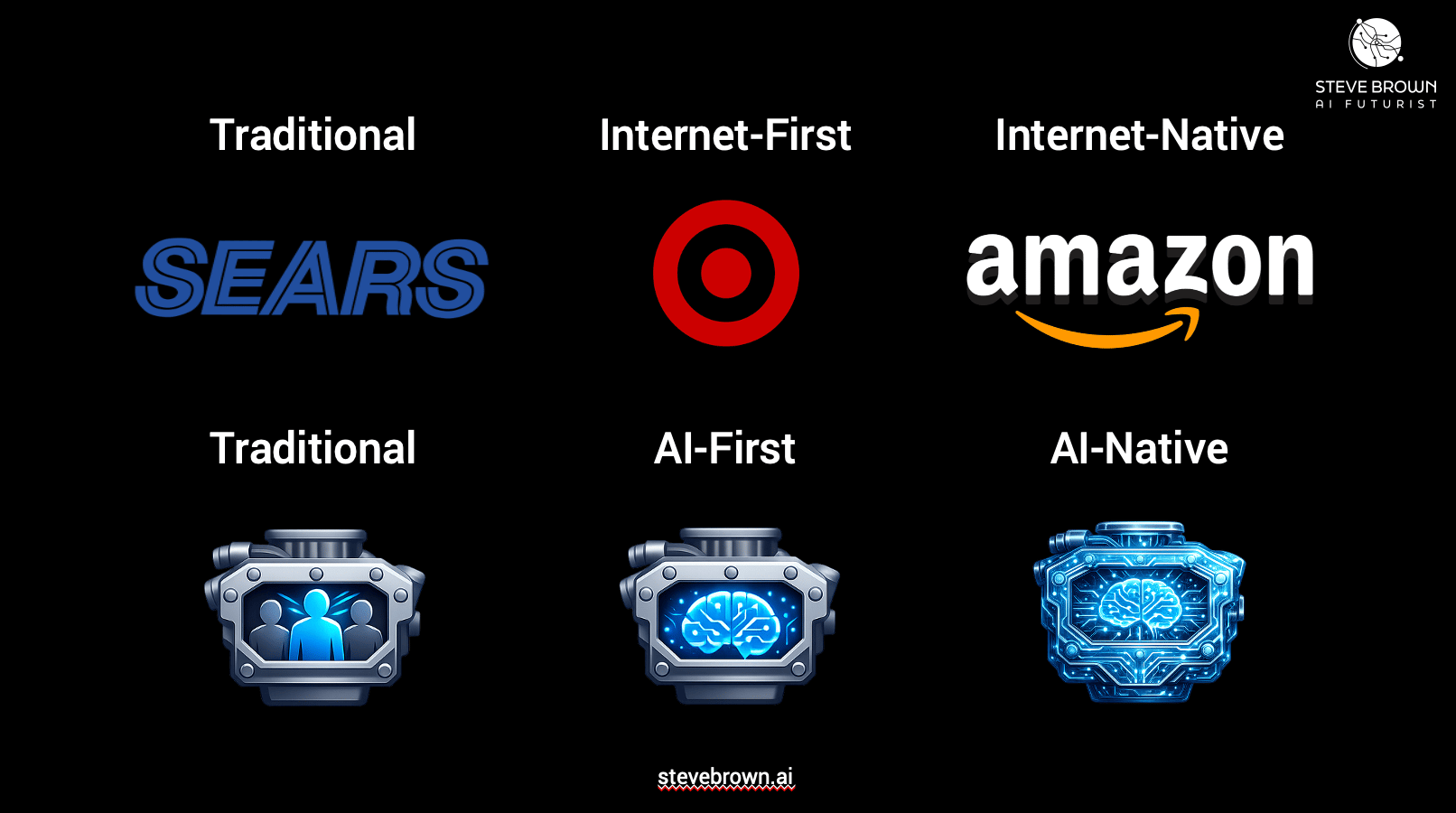
To understand where this is going, it helps to look at the last major technological revolution. The rise of the Internet created three kinds of companies: traditional, internet-first, and internet-native.
Traditional Companies
Traditional companies built their businesses long before the internet existed. Many treated the internet as an afterthought. Sears is a classic example. Once the dominant retailer in America, it struggled to adapt to the digital era and ultimately fell behind. Companies like Kodak and Blockbuster also failed to make the leap, and sufffered the consequences.
Internet-First Companies
Some established companies successfully reorganized themselves around digital. They became Internet-first organizations. Target is a good example. It redesigned logistics, inventory, and fulfillment around e-commerce to compete in a digital world. It embraced omni-channel commerce to straddle the digital and physical worlds, taking full advantage of both.
Internet-Native Companies
Then there were companies built entirely for the new era. They didn’t adapt to the Internet. They were born on it.
Amazon is the canonical example. It wasn’t simply a retailer using the Internet. It was a retailer built around the Internet from day one.
The key insight is that only internet-first companies could remain competitive as internet-native companies rose to prominence. Traditional organizations faded away.
The Same Pattern Is Emerging With AI
Today, we are seeing the same pattern unfold again. But this time the shift is from digital-first to AI-first.
Traditional Companies
These organizations still operate using traditional workflows. Humans perform core thinking and decision-making.
Humans power the engine of the company. Software systems support execution.
AI may be used occasionally, but it’s not central to how work is done.
AI-First Companies
AI-first organizations redesign workflows around human–machine collaboration. AI powers the engine of operations. Intelligent systems participate directly in research, analysis, planning, design, and decision-making. Work becomes a partnership between people and intelligent machines.
In companies with physical operations, this partnership extends into the real world through AI-powered robots and autonomous systems. Warehouse robots. Autonomous delivery systems. Construction robots. AI-driven manufacturing. Autonomous wet labs.
The result is something new. Work becomes a team sport between humans and machines.
AI-Native Companies
The final category is companies that are built entirely for the AI era. These organizations assume intelligence is abundant from day one. These are the forward-looking startups of today. They design products, workflows, and business models accordingly.
AI-native companies will look dramatically different from the organizations we know today. They will be smaller, faster, and vastly more capable per employee.
In many cases, AI-native companies will scale with surprisingly small teams. Their impact will feel outsized. In the internet era, small, local companies could appear global. AI-native companies will be small teams with the operational scale, reach, and impact of giant enterprises.
When intelligence becomes infrastructure, the size of the organization ceases to be the primary driver of capability.
Headcount is decoupled from impact.
An AI-first company doesn’t just use AI—it reorganizes the entire business around it.
The Mistake Most Companies Are Making
Right now, many organizations are treating AI the same way they treated earlier technologies. They’re bolting it onto existing workflows.
Using AI to:
• Draft reports
• Summarize sales calls
• Generate marketing content
• Assist with customer service
These uses are helpful. But they represent incremental improvement, not transformation.
It’s the difference between adding electricity to a factory and redesigning the factory around electric power. The first improves efficiency. The second reinvents production.
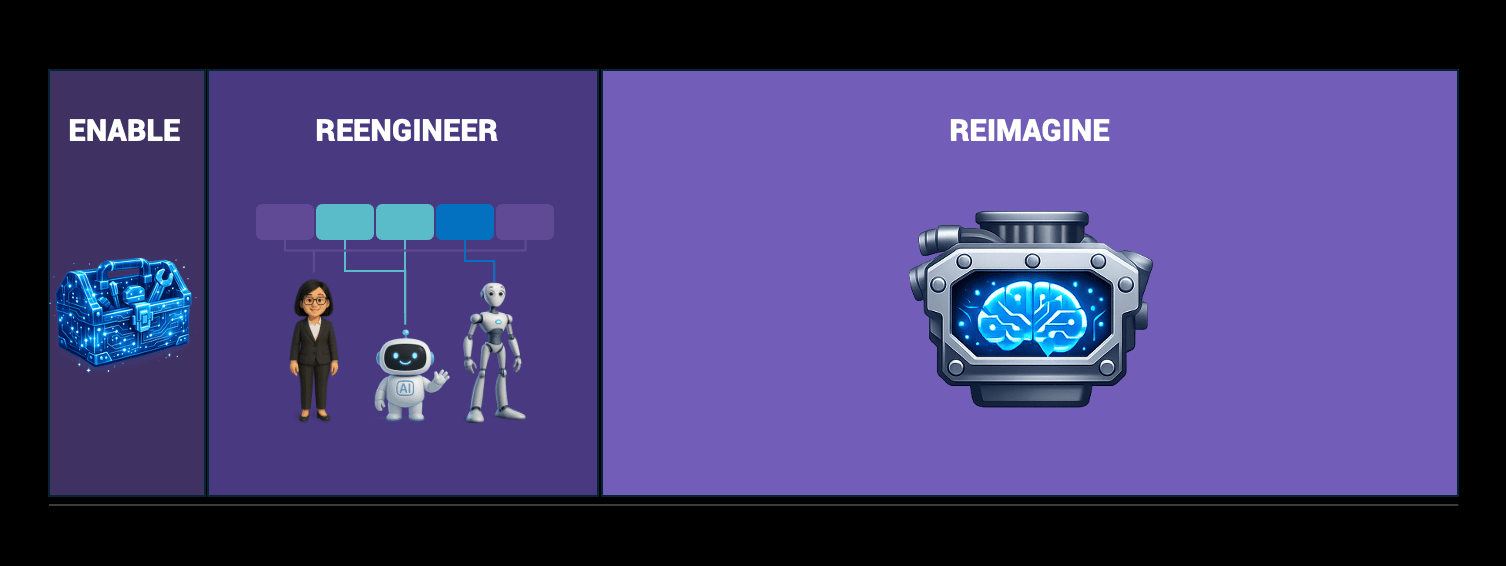
The Three Stages Of Becoming AI-First
In my work with leadership teams around the world, I see organizations progressing through three stages.
1. Enable
This is where most companies begin. Employees gain access to AI tools. Teams experiment with copilots and automation.
Enablement is important. People need to learn how these systems work. But here’s the reality: Enablement typically unlocks only 5–10% of the value of AI. Probably much less than that, if we are being honest.
Why? Because the underlying workflows remain unchanged. You’ve simply given people smarter tools.
2. Reengineer
This is where real value begins. Organizations start redesigning workflows around human-machine teams.
People stop doing the work. Instead, they design the work, then oversee it.
Every person on your team, no matter how junior, becomes a manager...of machines.
Scale ramps. Marginal costs fall. Job satisfaction rises. Impact increases.
Instead of inserting AI into existing processes, they rethink the process itself. Work is divided up and orchestrated across a blended workforce of people, digital employees (AI agents), and robots working in tight collaboration.
Work becomes dramatically faster and more exploratory. The speed of iteration increases. And innovation accelerates. Reengineering is perhaps 30% of the overall AI transformation effort, and deliver 30-40% of AI’s value.

Retail workflow reengineering
Imagine a retail store preparing for a busy weekend.
AI agents analyze weather, local events, sales trends, and online activity to forecast demand. They recommend markdown strategies, highlight which products should be featured, suggest how merchandise should be arranged on the floor—and even contact two on-call temp workers to help handle the expected rush.
A humanoid robot works the store overnight—restocking shelves, moving displays, and preparing pickup orders for the morning rush. It works through the day, folding garments and keeping the store clean and tidy.
Human employees focus on what people do best: helping customers, offering styling advice, curating the shopping experience, and making judgment calls about merchandising while overseeing the intelligent systems running behind the scenes.
The machines handle the routine work.
The humans elevate the experience.
They’re no longer doing every task themselves.
They’re orchestrating a workforce of people, AI agents, and robots working together.
3. Reimagine
The final stage is when companies begin to reinvent the business itself. Products change. Business models change. Entire industries shift.
Insurance becomes predictive rather than reactive. Healthcare becomes continuous rather than episodic. Retail becomes hyper-personalized and AI-driven.
And in the physical world, robots increasingly perform routine operational work. Factories, warehouses, farms, and construction sites begin to look very different when AI-powered machines become part of the workforce.
The company becomes AI-first. AI is the engine at the heart of operations. People steer the engine and add human-only value related to connection, empathy, and creativity. Getting to this final stage represents half or two-thirds of the total effort but yields the majority of the value AI can unlock.
Why AI-First Organizations Will Win
AI-first companies gain structural advantages that are difficult for traditional organizations to match.
Speed
AI dramatically compresses the time required for cognitive tasks. Research that once took weeks can now happen in minutes. Design iterations that once required entire teams can be explored instantly. When thinking accelerates, innovation accelerates. Companies that reorganize around AI will move far faster than competitors still operating with traditional workflows.
Intelligence at Scale
Historically, intelligence was scarce. Organizations relied on a limited number of experts. AI changes that.
Now, intelligence can be scaled across the entire organization. Every employee can have access to world-class analysis and expert-level reasoning. This significantly enhances the workforce's capabilities. Expertise becomes a utility. Organizational capability discussions take a new direction.
It’s not about people or machines, but people and machines. The new HR equation is capability = people x machines.
AI amplifies human effort and impact.
Reinvented Roles
As AI takes on more cognitive tasks, human work evolves. People spend less time on routine tasks and more time on judgment, creativity, strategy, ethics, vision, and relationship building.
In other words, AI handles the thinking work that machines do best. Humans focus on the thinking that only humans can do. Work shifts towards higher-value human contributions, fueling huge demand for reskilling and upskilling.
The Leadership Challenge
The shift to AI-first is not primarily a technology challenge. It is a leadership challenge. Vision, courage, and conviction become primary leadership skills.
Executives must rethink fundamental questions:
How should work be organized when intelligence is abundant?
Which decisions should humans make—and which should machines make?
How do we redesign workflows around human–machine teams?
If AI removes all busywork, what would our people be free to create?
If our marginal cost fell towards zero, what becomes possible?
If execution took days instead of years, what new businesses could we pursue?
If our best employees could be everywhere at once, what would we build?
What could we do differently if we could amplify our employee impact 100-fold?
And what new products or services become possible if we do?
How do we change the point of competition by amplifying our people and collapsing constraints to deliver abundance at scale?
These questions require leaders to rethink assumptions that have guided organizations for decades. That’s uncomfortable. But it’s also where the biggest opportunities lie.
Some Companies Will Struggle
Some organizations will move quickly. Others will hesitate.
The companies most at risk are those that treat AI as simply another tool to deploy. History suggests this rarely works. Companies that approached the internet as a marketing channel were overtaken by companies that rebuilt their businesses around digital platforms.
The pattern is likely to repeat.
Organizations that merely use AI will compete against organizations that are built around AI. And those are very different competitors.
The Question That Matters Most
The most important question leaders should be asking today is not: “How should we use AI?”
It’s this: “What would our company look like if we built it today in a world where intelligence is abundant?”
That question forces a much deeper rethink. It challenges assumptions about workflows, products, and even organizational structure. And it’s the question that will define the next generation of market leaders.
The most important role-playing game leaders can play today: Imagine forming a fierce AI-native competitor to your existing business; use those insight to fuel your AI-first strategy.
The Future Is AI-First
Every technological era produces new kinds of organizations. The industrial era created the modern corporation. The Internet era created digital platforms. The AI era will create AI-first organizations.
Companies that redesign themselves around intelligence—rather than simply adopting AI tools—will move faster, innovate more effectively, and deliver entirely new forms of value.
Or put more simply: The winners of the AI era won’t just use AI. They’ll build their entire business around it.
The shift won’t happen overnight. But it has already begun. And the companies that rethink their businesses now will be the ones that define the next era of competition.
Because AI won’t just change how companies work.
It will change what a company is.
Next Issue
In the next issue of Synthetic, we will go beyond the abstract notion of “AI First” to explore three examples of AI-First Companies spanning Media, Medicine, and Fast Fashion.
88% resolved. 22% stayed loyal. What went wrong?

That's the AI paradox hiding in your CX stack. Tickets close. Customers leave. And most teams don't see it coming because they're measuring the wrong things.
Efficiency metrics look great on paper. Handle time down. Containment rate up. But customer loyalty? That's a different story — and it's one your current dashboards probably aren't telling you.
Gladly's 2026 Customer Expectations Report surveyed thousands of real consumers to find out exactly where AI-powered service breaks trust, and what separates the platforms that drive retention from the ones that quietly erode it.
If you're architecting the CX stack, this is the data you need to build it right. Not just fast. Not just cheap. Built to last.